Open Source Lac de données:
Enterprise Analytics Without Vendor Lock-in
Ilum delivers the complete data lakehouse experience with integrated SQL editor, Jupyter notebooks, automatic data lineage, and native BI connectivity—all on Kubernetes. The modern alternative to Databricks and Cloudera without licensing fees or vendor constraints.

Complete Data Lakehouse Platform


Complete Data Platform
Unified data lakehouse platform with integrated SQL editor, Jupyter notebooks, data lineage, and BI connectivity. Everything you need for modern analytics in one open-source solution.
Kubernetes-Native Architecture
Built from the ground up for Kubernetes, ensuring enterprise-grade scalability, reliability, and resource optimization. Deploy anywhere: cloud, on-premise, or hybrid environments.

Zero Vendor Lock-in
Open-source platform with modular architecture. Choose your preferred storage (S3, HDFS, GCS), processing engines, and BI tools without proprietary constraints or licensing fees.
Qu’est-ce qu’un Data Lakehouse ?
Organizations need robust and flexible solutions to manage and analyze vast amounts of information. The open source data lakehouse architecture emerges as a compelling alternative to traditional data warehouses and data lakes, offering a unified platform for diverse data types et advanced analytics. This article explores the data lakehouse concept, highlighting its benefits and showcasing why ILUM stands out as the best solution for enterprises seeking control, scalability, and innovation.
Un data lakehouse is the fastest-growing data architecture, combining the flexibility and cost-effectiveness of data lakes with the performance and management features of data warehouses. The global data lakehouse market is projected to grow from $8.9 billion in 2023 to $66.4 billion by 2033 at a 22.9% CAGR. This revolutionary architecture enables unified analytics on structured and unstructured data, providing greater agility with less data redundancy, simpler setup, and consistent analytics views compared to traditional fragmented approaches.
Complete Data Lakehouse Platform
Built on proven open-source technologies like Apache Spark, Lac Delta, Apache Iceberget Apache Hudi, Ilum delivers enterprise-grade table formats with ACID transactions, schema evolutionet time travel capabilities. Unlike fragmented solutions, Ilum integrates everything in one platform - from data ingestion to ML workflows and BI visualization.
SQL Editor & Query Engine
Advanced SQL editor with support for Spark SQL, Delta Lake, Apache Iceberg, and Hudi. Built-in query optimization, collaborative features, and seamless data exploration capabilities.
Jupyter Integration
Native Jupyter notebooks with full Spark cluster access. Pre-installed ML libraries, collaborative environments, and seamless integration with your data lakehouse for advanced analytics.
Automatic Data Lineage
Built on OpenLineage framework for automatic data lineage tracking. Visual dependency graphs, compliance features, and complete audit trails without manual configuration.
Data Engineering Excellence: Building Robust Data Pipelines
Modern data engineering requires a comprehensive data platform that supports the entire data lifecycle. ILUM empowers data teams to build, monitor, and maintain production-grade data pipelines with built-in data reliability and real-time streaming data capabilities. From ingestion to transformation, ILUM ensures data freshness and quality at every step.
🔄 End-to-End Data Pipeline Management
Data engineering teams build scalable data pipelines using familiar tools like Apache Spark, dbt, and Airflow. ILUM's data platform provides built-in orchestration, monitoring, and alerting to ensure data reliability across batch and streaming data workflows.
⚡ Real-Time Streaming Data Processing
Process streaming data with Apache Kafka, Flink, and Spark Streaming integration. Build real-time data pipelines that maintain data freshness for time-sensitive analytics and operational use cases. Sub-second latency for mission-critical applications.
👥 Collaborative Data Engineering
Data teams collaborate seamlessly with shared notebooks, SQL editors, and version-controlled data pipelines. The unified data platform eliminates silos between data engineering, analytics, and ML teams while ensuring data reliability through automated testing and validation.
Benefits of Adopting a Data Lakehouse Architecture
Adopting a data lakehouse architecture offers numerous benefits for modern enterprises. This unified approach transforms how organizations manage, process, and analyze data while reducing complexity and costs. Specifically, it provides several key advantages:
🎯 Unified Platform for All Data Types
Eliminate the need to maintain separate data lakes and data warehouses. Handle structured, semi-structured, and unstructured data in a single platform. This simplifies data management, reduces infrastructure costs, and eliminates data silos that slow down analytics.
⚡ Support for Diverse Workloads
Empower data analysts, data scientists, and business users to extract valuable insights from diverse data. ILUM streamlines access to new data sources and reduces processing times by up to 10x. Support for SQL analytics, machine learning, real-time streaming, and batch processing - all on the same platform.
🔒 Enhanced Data Governance
Provide a centralized data store with consistent security policies and access controls. Ensure data integrity and reliability with ACID transactions, audit logging, and compliance frameworks. Single source of truth eliminates data inconsistencies and simplifies regulatory compliance.
The Open Source Advantage
With the data lake market growing at 23.8% CAGR and reaching $13.62 billion in 2023, enterprises are seeking cost-effective alternatives. Ilum delivers $300K-500K+ annual savings vs. proprietary platforms while providing complete feature parity including advanced table formats, ACID transactions, and schema evolution - all without vendor lock-in or licensing restrictions.

BI Connectivity
Native JDBC/ODBC support for connecting Tableau, Power BI, Apache Superset, and other BI tools. Built-in visualization capabilities and query acceleration for optimal performance.

Prise en charge multi-clusters
Connect and manage multiple Kubernetes, YARN, and local clusters simultaneously. Perfect for migrations, testing, and multi-environment data operations.

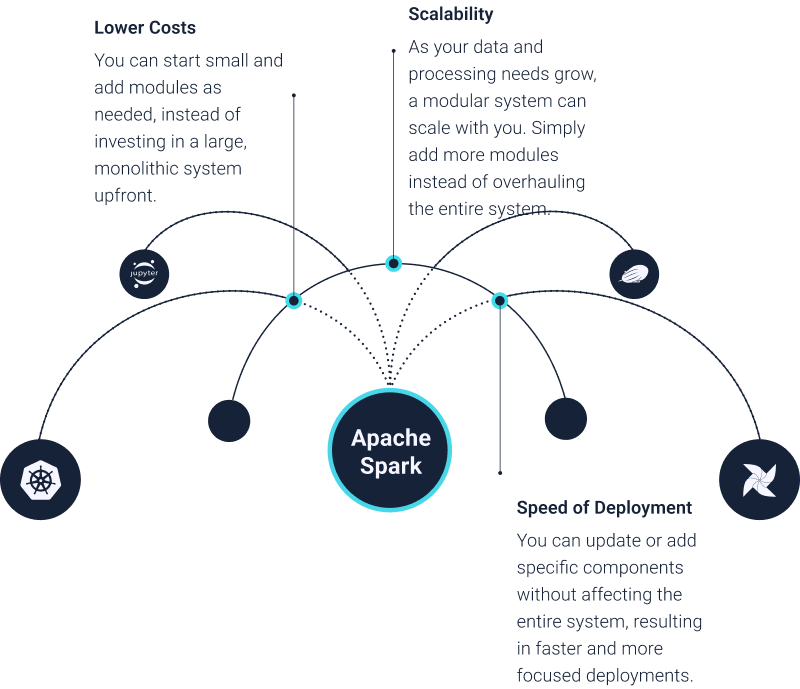
Spark Microservices
Long-lived Spark sessions eliminate initialization delays. Perfect for real-time APIs, RAG workflows, and interactive data applications with sub-second response times.
🆚 Databricks: Save $300K+ Annually
Zero per-user fees • Full feature access • Multi-cluster support • True Kubernetes-native architecture
🆚 Cloudera: Modern vs. Legacy
Container-native design • Auto-scaling capabilities • Open source freedom • No vendor lock-in
🆚 Enterprise Freedom
Deploy anywhere • Complete data control • Unlimited extensibility • Future-proof architecture
Complete Analytics Workflow
From data ingestion to visualization, Ilum handles your entire analytics pipeline. Built-in SQL editor with Spark SQL, Delta Lake, and Iceberg support. Native Jupyter notebooks with full cluster access. Automatic Traçabilité des données tracking with OpenLineage. Direct BI tool connectivity via JDBC/ODBC. Learn more about our complete platform features et technical architecture.
Start Free Trial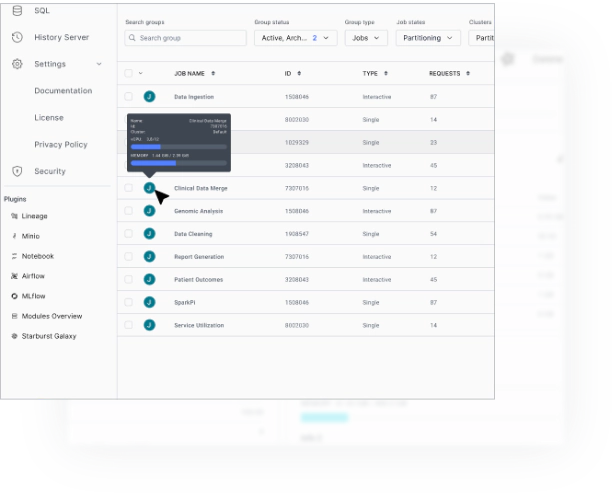
Kubernetes-Native Architecture
Built from the ground up for Kubernetes, Ilum delivers true cloud-native scalability and reliability. Auto-scaling based on workload demands, fault tolerance with automatic recovery, and resource optimization for cost efficiency. Deploy on any Kubernetes cluster: AWS EKS, Google GKE, Azure AKS, or on-premise.
Multi-Cluster Data Operations
Connect and manage multiple clusters simultaneously—perfect for data migrations, multi-environment testinget hybrid cloud deployments. Seamlessly move data between Kubernetes, YARN, and local clusters. Advanced cluster orchestration with automated failover and load balancing.
Performance at Scale
Ilum delivers enterprise-grade performance with optimized query execution, efficient resource utilization, and linear scalability across distributed clusters.
⚡ Query Performance
Sub-second response times for interactive queries. Spark microservices eliminate 20-40 second job startup delays. Adaptive query optimization and vectorized execution for complex analytics.
📈 Scalability Metrics
Linear scaling from gigabytes to petabytes. Process 1TB+ datasets efficiently. Auto-scaling based on workload demands with 99.9% uptime and fault tolerance.
💰 Resource Efficiency
Kubernetes-native resource management reduces infrastructure costs by 30-50%. Dynamic allocation, spot instance support, and optimized container scheduling.
Real-World Use Cases
From Fortune 500 enterprises to innovative startups, organizations worldwide trust Ilum for their most critical data lakehouse deployments.
Enterprise Data Migration
Large enterprises successfully migrate from legacy Hadoop and proprietary data warehouse systems to Ilum's modern data lakehouse architecture. 50-80% cost reduction in infrastructure and licensing. 10x faster deployment times. Zero vendor lock-in ensures future flexibility and technology choice.
View the Hadoop & Cloudera migration guideReal-Time Analytics & ML
Data science teams leverage Ilum's integrated Jupyter environments and Spark microservices for real-time model serving, streaming analyticset MLOps workflows. Native support for popular ML frameworks including MLflow, TensorFlow, and PyTorch with seamless model deployment.
Multi-Tenant SaaS Platforms
SaaS providers use Ilum's Kubernetes-native architecture for secure multi-tenancy, elastic scalinget cost-effective analytics. Namespace isolation, RBAC integration, and automated resource management support thousands of concurrent users.
Empowering Data Scientists and Machine Learning Workflows
Data scientists and machine learning engineers need immediate access to high-quality, fresh data. ILUM provides a unified environment where teams can explore, prepare, and use data for machine learning models without complex ETL processes. From exploratory Analyse des données to production ML pipelines, ILUM ensures data freshness and eliminates data preparation bottlenecks.
🤖 Streamlined ML Data Preparation
Data scientists and machine learning teams directly use data from the lakehouse without copying or moving datasets. Integrated Jupyter notebooks with Spark provide instant access to terabytes of data for machine learning. Data freshness is maintained through real-time sync with source systems.
📊 Interactive Data Analytics & Exploration
Perform exploratory Analyse des données with interactive SQL queries and visual notebooks. Data scientists explore datasets, validate hypotheses, and prototype models using the same données that powers production systems. No delays from data movement or transformation.
🚀 Production ML Pipeline Deployment
Deploy apprentissage automatique models with MLflow integration and automated feature engineering pipelines. Use data directly from the lakehouse for real-time inference and batch scoring. Maintain data freshness with streaming feature updates and automated retraining workflows.
Integration Ecosystem
Ilum's open architecture integrates seamlessly with your existing data stack. Connect any data source, use any BI tool, deploy on any infrastructure.
🔗 Data Integration
Apache Kafka, Apache NiFi, Airbyte, Fivetran, Apache Airflow, dbt. Stream processing with Kafka Streams and Flink. Change data capture (CDC) from databases.
📊 BI & Visualization
Tableau, Power BI, Apache Superset, Grafana, Looker, Qlik. Native JDBC/ODBC drivers with optimized performance. Custom dashboards and embedded analytics.
🤖 ML & AI Platforms
MLflow, Kubeflow, TensorFlow, PyTorch, Scikit-learn, Jupyter, Apache Zeppelin. Feature stores, model registries, and automated ML pipelines.
Universal Data Access: Query Data Across Any Format
Modern organizations need to query data stored in multiple formats without complex transformations. ILUM provides universal access to data whether it's structured, semi-structured data, or unstructured. As a flexible data storage system, ILUM supports big data workloads while enabling teams to use data in any data format including Parquet, JSON, CSV, Avro, and open data formats.
🔍 Multi-Format Query Engine
Query data directly in any data format without preprocessing. SQL queries seamlessly work across Parquet, Delta Lake, Iceberg, JSON, and CSV files. Handle semi-structured data like nested JSON and XML alongside structured tables. Native support for open data standards ensures interoperability.
📁 Flexible Data Storage System
As a modern data storage system, ILUM handles big data workloads from gigabytes to petabytes. Access to data is unified regardless of where it's stored - S3, MinIO, HDFS, or local storage. Support for multiple data format types eliminates data silos and duplication.
🌐 Open Data Standards & APIs
Use data through standard SQL, REST APIs, or programming interfaces. Support for open data formats and protocols ensures vendor-neutral access to data. Semi-structured data handling with schema-on-read capabilities enables exploratory analytics on any data format.
Advanced Table Format Support
Ilum supports all major open-source lakehouse table formats: Lac Delta, Apache Iceberget Apache Hudi. Each provides ACID transactions, schema evolution, time travelet partition evolution capabilities, enabling enterprise-grade data management with optimized query performance and data consistency.
🚀 Delta Lake & Spark SQL
Full Delta Lake 3.3.0 support with ACID transactions, time travel queries, and schema evolution. Advanced SQL editor with intelligent completion, query optimization, and collaborative features. Process 1M+ row result sets with streaming.
🧊 Apache Iceberg Integration
Native Iceberg support with hidden partitioning, partition evolution, and optimized metadata handling. Superior performance for non-expert users with automatic partition pruning and advanced query optimization.
🔄 Apache Hudi Capabilities
Complete Hudi integration for incremental data processing, record-level updates, and change data capture (CDC). Ideal for real-time data ingestion with automatic compaction and data optimization.
Overview of ILUM's Architecture
ILUM stands out as the best lakehouse architecture, designed with a clear separation between the control plane and the data plane. This separation ensures efficient data processing et enhanced scalability. The architecture leverages proven cloud-native patterns to deliver enterprise-grade performance while maintaining flexibility and cost-efficiency.
⚙️ Data Plane: Compute & Storage
Powered by Apache Spark on Kubernetes, the data plane handles all compute tasks using pods as drivers and executors. Storage is flexible, supporting S3, MinIO, and Ceph for storing Parquet, Delta, and Iceberg tables. Auto-scaling ensures optimal resource utilization while maintaining high performance.
🎛️ Control Plane: Orchestration & Governance
The control plane manages data governance, cataloging, and orchestration, making ILUM a robust platform for diverse data workloads. Centralized metadata management, job scheduling, user authentication, and access control policies ensure enterprise-grade security and compliance.
🔗 Separation Benefits
This architectural separation enables independent scaling of control and compute resources, fault isolation for better reliability, and multi-cluster support across hybrid environments. Deploy control plane once, connect unlimited data planes across clouds, on-premise, or edge locations.
How Lakehouse Combines the Best of Both Worlds
The debate of data warehouse vs data lake is resolved by the lakehouse architecture. A lakehouse combines the flexibility and cost-effectiveness of data lakes with the performance and reliability of data warehouse and a data lake features. Organizations no longer need to choose between a data warehouse vs data lake - the lakehouse provides unified Analyse des données avec data reliability on a single data storage system.
🏛️ From Data Warehouse to Lakehouse
Traditional data warehouse and a data lake separation creates complexity and duplication. A lakehouse combines warehouse-grade SQL performance with lake-scale storage. Execute complex Analyse des données queries with data reliability guarantees while storing data cost-effectively.
🌊 Beyond Data Lake Limitations
Pendant que data warehouse vs data lake debates focus on trade-offs, the lakehouse combines advantages of both. Maintain ACID transactions and schema enforcement (warehouse benefits) while supporting diverse data types and formats (lake benefits). Single data storage system for all workloads.
✨ Unified Data Analytics Platform
Un lakehouse combines BI, Analyse des données, and ML workloads on one platform. No more data warehouse vs data lake decision - use the same data for reporting, advanced analytics, and machine learning. Ensure data reliability across all use cases with consistent governance and quality controls.
Data Lake vs. Data Warehouse: Key Differences
Data lakes and data warehouses serve distinct purposes in data storage and analytics. Understanding their differences is crucial for choosing the right architecture. Data warehouses deliver clean, structured data for BI analytics, while data lakes permanently and cheaply store data of any nature in any format. However, data lakes solve most warehouse challenges but lose some key features. Data lakehouses bring the best of both worlds - combining lake flexibility with warehouse performance and management capabilities.
🏢 Data Warehouse Characteristics
Data warehouses are optimized for structured data, providing fast query performance for business data analysis. They typically involve a more rigid data model, requiring data to be transformed and loaded into a predefined schema. Ideal for reporting and BI workloads but expensive and limited in handling diverse data types.
🌊 Data Lake Characteristics
Data lakes are designed to store raw data in its native format, regardless of structure. This flexibility makes them ideal for data ingestion from diverse data sources, including unstructured data like images, videos, and logs. Cost-effective storage but often lacks the governance and performance needed for production analytics.
🎯 Choosing the Right Approach
Choosing between a data lake and a data warehouse depends on your organization's specific data needs and analytics goals. However, data lakehouses eliminate this choice by providing both structured analytics performance and unstructured data flexibility in a unified platform.
🏢 Data Warehouse Limitations
Expensive proprietary licensing, rigid schema requirements, limited scalability, complex ETL processes. Struggles with unstructured data, real-time processing, and modern analytics workloads.
🌊 Data Lake Challenges
Data swamps without governance, inconsistent performance, complex data management, limited ACID support. Difficult to ensure data quality and provide reliable analytics.
🏡 Lakehouse Solution
ACID transactions on data lakes, schema enforcement and evolution, unified batch and streaming, cost-effective storage with warehouse performance. Best of both architectures.
Kubernetes-Native Architecture
Built specifically for Kubernetes with microservices design, custom operatorset native resource management. Superior scalability, fault isolation, and rolling updates compared to retrofitted platforms.
View Architecture GuideComplete Open Source Data Lakehouse
Everything integrated in one platform. Save $300K-500K+ annually vs. proprietary solutions with zero licensing costs, enterprise-grade security, and future-proof Kubernetes architecture.
Enterprise Security & Compliance
End-to-end encryption, RBAC, audit logging, SOC 2/HIPAA/GDPR compliance. Multi-factor authentication, SAML/OIDC integration, and automated compliance reporting—all included.
Performance & Scalability
Spark microservices eliminate startup delays. Linear scaling from GB to PB. 99.9% uptime with auto-scaling, fault tolerance, and 30-50% infrastructure cost reduction.
Déployez n’importe où
Cloud (AWS/GKE/Azure), on-premise, hybrid, or edge. Kubernetes-native with Terraform/Helm charts. Air-gapped environments and IoT deployments supported.
Proven Performance & Real Success Stories
2.3x faster than Cloudera, $2M+ annual savings for enterprise customers. Real-world results from production deployments across industries.
🏦 Financial Services: $2M Annual Savings
Major bank: 500TB migration, 5x faster queries, 99.99% uptime. Real-time fraud detection processing 1M+ transactions/second with sub-100ms latency.
🏥 Healthcare: 80% Faster Reporting
Regional network: 50TB+ patient data, full HIPAA compliance, automated auditing. Real-time population health analytics serving 2M+ patients.
🏭 Manufacturing: Predictive Analytics
IoT data processing, predictive maintenance, quality control analytics. Edge to cloud data consolidation with real-time monitoring dashboards.
Commencez gratuitement
Profitez de toutes nos fonctionnalités sur Pas de frais. Pour les entreprises ayant des besoins uniques, nous proposons des plans sur mesure pour répondre à vos besoins.
Ready to Get Started?
Deploy in 5 minutes with Docker Compose or get enterprise migration support. Join thousands of organizations already benefiting from open-source data lakehouse architecture.
Key Questions Answered
Everything you need to know about Ilum's open-source data lakehouse platform.
💰 How much can I save vs. proprietary platforms?
Save $300K-500K+ annually vs. Databricks/Cloudera. Zero licensing costs, same enterprise features, full deployment control. ROI typically achieved in 3-6 months.
🔄 Can I migrate from legacy systems?
Yes! Automated migration tools for Hadoop/Cloudera with step-by-step guidance, data validation, and professional services. Proven migration methodology minimizes risk.
🔒 Is it enterprise-secure and compliant?
Enterprise-grade security with encryption, RBAC, audit logging. Full compliance support (SOC 2, HIPAA, GDPR). Connect existing BI tools via JDBC/ODBC.
Vous avez des idées pour améliorer Ilum ?
Nous apprécions vos commentaires et sommes toujours désireux de nous améliorer. Si vous avez des suggestions qui pourraient améliorer votre expérience ou faciliter la navigation dans le produit, n’hésitez pas à nous le faire savoir. Rejoignez-nous pour façonner l’avenir de notre plateforme ! Votre contribution compte.
Ajouter une demande de fonctionnalité