Maillage de données : Decentralized Data Ownership
Implement data mesh architecture with Ilum's domain-oriented platform. Enable decentralized data ownership, self-serve infrastructureet federated governance based on Zhamak Dehghani's revolutionary paradigm. Move beyond centralized data bottlenecks to scalable, domain-driven data management.

Four Foundational Principles of Data Mesh

Four Foundational Data Mesh Principles
The complete framework that enables scalable, decentralized data architecture with proper governance

Domain-Oriented Ownership
Decentralized data ownership where domain teams take full responsibility for their analytical data, eliminating centralized bottlenecks and ensuring data context and quality.

Data as a Product
Treat data as a product with clear ownership, SLAs, and quality guarantees. Domain teams serve trusted, discoverable data products to internal consumers.

Self-Serve Data Infrastructure
Provide domain teams with self-service platform capabilities for data processing, storage, and governance without relying on centralized data teams.
Federated Computational Governance
Balance domain autonomy with organizational consistency through federated governance. Establish global standards for interoperability, security, and compliance while allowing domain-specific implementations.
Data Architecture Approaches Comparison
Understanding when and why to choose data mesh over other architectural patterns
Centralized Data Platform
**Benefits:** Single source of truth, Centralized governance, Simplified architecture **Challenges:** Bottlenecks at scale, Lacks domain context, Slow to adapt to changes, Monolithic complexity **Best For:** Small organizations with simple data needs
Maillage de données
**Benefits:** Domain autonomy, Scalable ownership, Better data quality, Faster innovation **Challenges:** Complex coordination, Requires cultural change, Need for platform investment **Best For:** Large enterprises with diverse data domains
Lac de données
**Benefits:** Unified storage, ACID transactions, Schema evolution, Cost-effective **Challenges:** Still centralized, Technical focus only, Limited organizational change **Best For:** Technical modernization without organizational restructuring
Qu’est-ce que le Data Mesh ?
Data mesh is a decentralized data architecture paradigm coined by Zhamak Dehghani in 2019, founded on four fundamental principles. Unlike traditional centralized approaches, data mesh treats analytical data as a product owned by domain teams, eliminating bottlenecks and ensuring end-to-end ownership of domain data to extract full potential from organizational data assets.
📈 Growing Adoption Rate
According to Gartner, 25% of large enterprises will implement data mesh principles by 2025, driven by the need for scalable data architectures that eliminate centralized bottlenecks.
🏢 Enterprise Success Stories
Companies like Netflix, Uber, and Airbnb have successfully implemented data mesh principles, reducing data delivery time by 70% and improving data quality through domain ownership.
💰 ROI and Business Impact
Organizations implementing data mesh report 40% faster time-to-market for data products and 50% reduction in data platform team workload, enabling better resource allocation.
Data Mesh vs. Traditional Approaches
Data mesh addresses the limitations of centralized data platforms by decentralizing not just data ownership but infrastructure. While data lakes and warehouses focus on technology, data mesh emphasizes organizational principles et federated governance to scale data operations.
🏢 Centralized Data Platform Challenges
Monolithic data platforms create silos and bottlenecks. Data platform engineers become overwhelmed ensuring access to the right data for diverse use cases, leading to delayed insights and reduced agility.
🌊 Data Mesh Solution
Domain-oriented decentralized ownership eliminates bottlenecks. Teams own their data end-to-end with self-serve infrastructure, enabling faster innovation and better data quality through domain expertise.
⚖️ Data Mesh vs. Data Lakehouse
Data lakehouse is a technology architecture, while data mesh is an organizational paradigm. Data mesh can be implemented using lakehouse technologies with proper domain boundaries and governance.
Conception orientée domaine
Ilum prend en charge la propriété orientée domaine, permettant aux équipes de gérer indépendamment leurs pipelines de données et de fournir des produits de données fiables et de haute qualité.
Infrastructure libre-service
Donnez à vos équipes les moyens d’utiliser la plateforme modulaire d’Ilum, qui fournit des outils permettant de rationaliser le déploiement, le traitement et la consommation des données sans dépendre de goulets d’étranglement centralisés.
Évolutivité et flexibilité
L’architecture cloud native d’Ilum garantit que votre infrastructure de données évolue de manière transparente dans des environnements cloud, sur site ou hybrides.

Comment Ilum permet le maillage de données
La conception modulaire et ouverte d’Ilum en fait la plate-forme idéale pour la mise en œuvre du Data Mesh. En s’intégrant à des outils standard tels qu’Apache Spark, Jupyter et Apache Airflow, Ilum fournit les éléments de base nécessaires à la propriété et à la gouvernance des données spécifiques à un domaine, tout en garantissant une collaboration transparente entre les équipes.
Architecture modulaire pour le maillage de données
La conception modulaire d’Ilum permet à chaque domaine de gérer indépendamment ses pipelines de données à l’aide de microservices conteneurisés orchestrés via Kubernetes. Cette architecture réduit la dépendance à l’égard des équipes centralisées, ce qui permet aux domaines de déployer, d’évoluer et d’optimiser leurs flux de travail de manière autonome. Grâce à la prise en charge intégrée d’outils tels que Spark et Airflow, Ilum garantit une intégration transparente et l’isolation des ressources, améliorant ainsi l’agilité et la fiabilité dans l’ensemble de l’organisation.
Obtenez-le gratuitement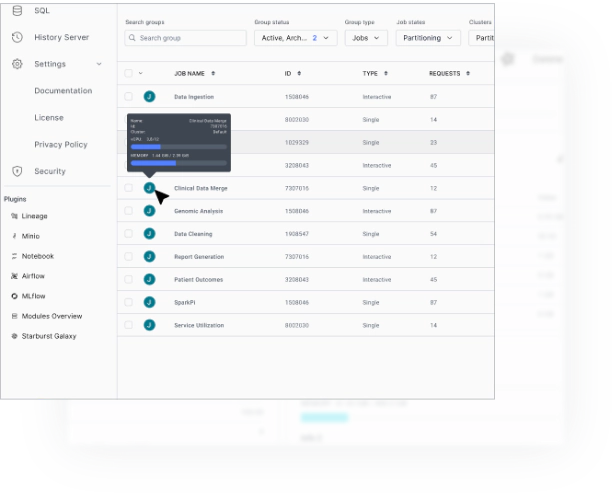
Amélioration de la collaboration entre les équipes
La plateforme unifiée d’Ilum comble le fossé entre les domaines en fournissant une infrastructure partagée qui favorise la cohérence et l’intégration. Dans le même temps, il permet à chaque domaine de garder un contrôle total sur ses opérations de données, garantissant l’autonomie et l’alignement avec les besoins spécifiques de l’entreprise. Cet équilibre favorise la collaboration, réduit les silos et améliore la productivité des équipes.
Déployez n’importe où
L’architecture flexible d’Ilum prend en charge le déploiement dans des environnements cloud, sur site et hybrides, ce qui la rend adaptable à toute configuration organisationnelle. Cela garantit que le Data Mesh peut être mis en œuvre de manière transparente, quelle que soit l’infrastructure existante, offrant évolutivité et compatibilité avec l’évolution des besoins de l’entreprise.
Commencez gratuitement
Profitez de toutes nos fonctionnalités sur Pas de frais. Pour les entreprises ayant des besoins uniques, nous proposons des plans sur mesure pour répondre à vos besoins.

Data Product Standards & Specifications
Successful data mesh implementation requires clear data product specifications that define quality, discoverability, and interoperability standards across all domains.
🔍 Discoverability Requirements
Data products must include comprehensive metadata: schema definitions, data lineage, business glossary terms, ownership information, and usage examples. Implement data catalogs with search and recommendation capabilities.
📊 Quality & SLA Standards
Define measurable quality metrics: completeness, accuracy, timeliness, and consistency. Establish SLAs for data freshness, availability (99.9% uptime), and response time (<2s for queries). Monitor and alert on violations.
🔒 Security & Compliance
Implement role-based access control, data classification (public, internal, restricted), encryption at rest and in transit, and audit logging. Ensure GDPR, CCPA, and industry-specific compliance requirements.
Data Mesh Implementation Roadmap
A systematic approach to migrating from centralized data platforms to domain-oriented data mesh architecture with measurable milestones.
🎯 Phase 1: Foundation (Months 1-3)
Identify domain boundaries, establish data product standards, set up self-serve infrastructure platform. Begin with 1-2 pilot domains. Define governance framework and quality metrics.
🏗️ Phase 2: Platform Development (Months 4-8)
Build self-serve data infrastructure, implement data catalog, establish CI/CD pipelines for data products. Migrate pilot domains, train domain teams, establish support processes.
📈 Phase 3: Scale & Optimize (Months 9-18)
Onboard remaining domains gradually, optimize platform based on feedback, establish cross-domain data sharing patterns. Monitor adoption metrics and business impact continuously.
Real-World Data Mesh Success Stories
Learn from organizations that have successfully implemented data mesh principles with concrete metrics and domain boundary examples.
🚗 Mobility Platform Case Study
A ride-sharing company implemented data mesh with domains for Rider Experience, Driver Operations, and Financial Analytics. Result: 60% reduction in data request fulfillment time, 45% improvement in data quality scores.
🏪 E-commerce Domain Structure
Retail giant organized domains around Customer Journey, Inventory Management, and Marketing Analytics. Each domain serves 15-25 data products. Achieved 70% faster feature development and 80% reduction in data incidents.
🏦 Financial Services Transformation
Bank restructured around Risk Management, Customer Analytics, and Transaction Processing domains. Implemented federated governance for regulatory compliance. Reduced time-to-market for new data products by 55%.
Implementing Data Mesh with Ilum
Ilum's modular architecture et Kubernetes-native design provide the perfect foundation for data mesh implementation. Enable domain teams with self-serve infrastructure while maintaining federated governance et data product standards.
🔧 Self-Serve Data Infrastructure
Ilum provides centralized services for data management including storage, orchestration, ingestion, transformation, cataloging, and monitoring - all accessible via self-service APIs and interfaces.
🏗️ Domain-Driven Architecture
Kubernetes namespaces enable domain isolation with resource allocation, RBAC integration, and independent scaling. Each domain maintains full autonomy over their data operations.
📊 Federated Governance
Implement consistent data standards, quality metrics, and compliance policies across domains while allowing flexibility in implementation approaches and technology choices.
Data Mesh Implementation FAQ
Comprehensive answers to common questions about data mesh adoption, implementation challenges, and best practices.
❓ When should I adopt data mesh?
Consider data mesh when: (1) Your data platform team becomes a bottleneck, (2) Domain teams lack context about their data, (3) Data quality issues arise from centralized processing, (4) You have >50 data consumers across multiple business domains, (5) Traditional data governance creates more overhead than value.
🔄 How does data mesh scale?
Data mesh scales horizontally through domain proliferation. Each new domain independently manages its data products using self-serve infrastructure. Network effects emerge as domains consume each other's data products, creating a marketplace of trusted data assets.
🎯 What makes data mesh successful?
Success factors: (1) Executive sponsorship for organizational change, (2) Investment in self-serve platform capabilities, (3) Clear data product standards and governance, (4) Domain team training and support, (5) Gradual migration rather than big-bang approach, (6) Measuring business impact, not just technical metrics.
🏗️ How do I identify domain boundaries?
Use Domain-Driven Design principles: (1) Align with business capabilities and organizational structure, (2) Identify natural data ownership patterns, (3) Look for bounded contexts where teams have end-to-end responsibility, (4) Consider data usage patterns and consumer needs, (5) Ensure domains can operate independently.
💰 What's the ROI of data mesh?
Typical ROI includes: (1) 40-70% faster time-to-market for data products, (2) 50% reduction in central platform team workload, (3) 30-60% improvement in data quality through domain expertise, (4) Reduced operational costs through domain autonomy, (5) Improved business agility and decision-making speed.
⚠️ What are common implementation pitfalls?
Avoid these mistakes: (1) Implementing technology without organizational change, (2) Creating too many small domains without clear boundaries, (3) Insufficient investment in self-serve platform, (4) Lack of data product standards, (5) Missing federated governance framework, (6) Trying to migrate everything at once.
Data Mesh Readiness Assessment
Evaluate your organization's readiness for data mesh implementation across key dimensions: organizational maturity, technical capabilities, and cultural alignment.
🏢 Organizational Readiness
**High:** Clear domain boundaries, autonomous teams, business-driven data needs. **Medium:** Some domain structure, mixed autonomy, growing data complexity. **Low:** Centralized decision-making, unclear ownership, simple data needs. Recommendation: Start with pilot domains if Medium/High.
🔧 Technical Capabilities
**High:** Cloud-native infrastructure, containerization, APIs, DevOps culture. **Medium:** Some cloud adoption, basic automation, mixed practices. **Low:** On-premise legacy, manual processes, limited API usage. Recommendation: Invest in self-serve platform before scaling domains.
👥 Cultural Alignment
**High:** Product mindset, cross-functional teams, data-driven culture. **Medium:** Growing product thinking, some collaboration, increasing data literacy. **Low:** Project-based delivery, siloed teams, limited data awareness. Recommendation: Focus on change management and training.
Vous avez des idées pour améliorer Ilum ?
Nous apprécions vos commentaires et sommes toujours désireux de nous améliorer. Si vous avez des suggestions qui pourraient améliorer votre expérience ou faciliter la navigation dans le produit, n’hésitez pas à nous le faire savoir. Rejoignez-nous pour façonner l’avenir de notre plateforme ! Votre contribution compte.
Ajouter une demande de fonctionnalité🏗️ Built for Decentralization
Ilum's Kubernetes-native architecture supports domain-driven design with namespace isolation, independent scaling, and resource management for true decentralized data ownership.
🔗 Unified Data Access
Seamlessly integrate with S3, HDFS, Delta Lake, Iceberg, and other storage solutions. Provide universal data access across domains while maintaining security and governance.
📈 Scalable & Modular
Start with a single domain and scale your data mesh architecture organically. Ilum's modular platform grows with your organizational needs and domain complexity.